At 20, Hattiloo is Breaking Theater Out of the Box
Founder Ekundayo Bandele on 20 years of Hattiloo, the new Culture Box, and why Memphis was the only place this could happen.
Founder Ekundayo Bandele on 20 years of Hattiloo, the new Culture Box, and why Memphis was the only place this could happen.
Hattiloo Theatre is one of the few freestanding, independent Black theaters in the country. And, lucky for us, it’s in Memphis. So, of course I’ve appreciated it—from a distance. Even though I’d like to think of myself as a man of culture, I’ve just never really been that interested in theater. But I was eager to learn.
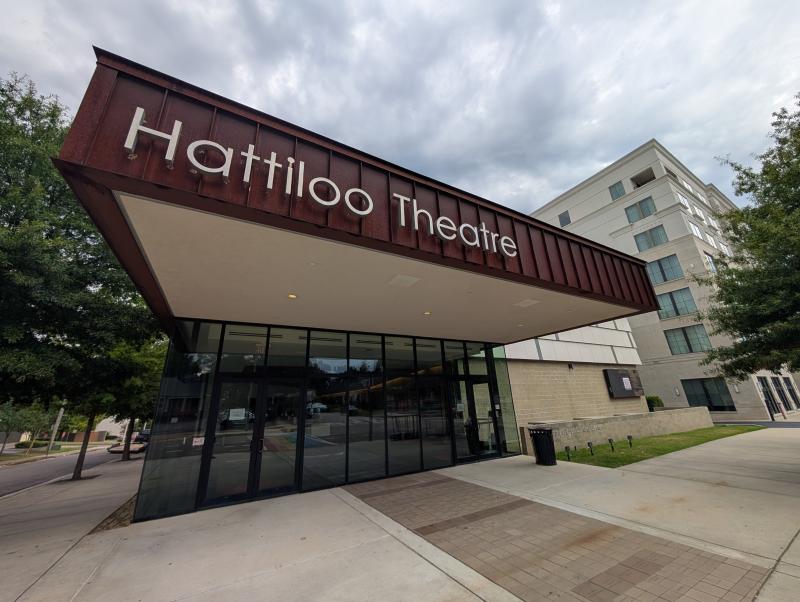
Walking into Hattiloo in Midtown’s Overton Square for the first time, I immediately realized I’d underestimated the place. Its large lobby, adorned with painted portraits of Black luminaries, felt polished yet warm. Cultured, if you will.
Sitting down with its founder, playwright and director Ekundayo Bandele, I was a little nervous to admit that I wasn’t a “theater guy,” but I thought it best to tell him and get that awkward bit out of the way.
To my surprise, he helped me feel at ease shockingly quickly, despite my ignorance. Don’t get me wrong, Bandele loves theater, and Hattiloo has plenty for those who share his passion. But as it turns out, getting people like me through the door has always been part of Hattiloo’s mission.
“Our mission is to develop a Black theater that is accessible to, relevant to, and reflective of a multicultural community," Bandele says. “To really pull people like yourself, you know, you aren't a theater person, out.”
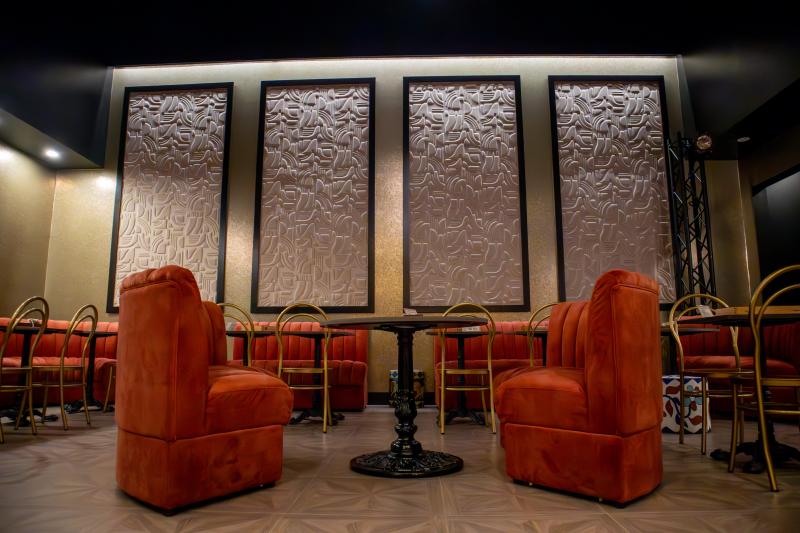
Two decades in, that has never been truer. Alongside an ambitious 20th season of stage productions, Hattiloo is launching Culture Box, an intimate new space for everything from comedy (Laugh Box) and live music (Music Box) to games (Toy Box), spoken word (Speaker Box Slam) and karaoke (Juke Box).
“You’re not a theater person, but one of these boxes is going to find you,” Bandele says.
Culture Box might be new, but the idea behind it isn’t. Bringing people together has been part of the Hattiloo story from the beginning.

What would a Black theater in Memphis look like?
What would a Black theater in Memphis look like?
Before there was a multimillion-dollar building, prominent board members, or an acclaimed actor on a playbill – before there was even a Hattiloo – Bandele’s production looked quite different. In the 90s, he put on plays in Memphis, renting various small theaters and hustling to build an audience by driving around town to stick his flyers in free weekly papers. The true genesis for Hattiloo was in 2005 at the Speakeasy, a weekly spoken-word event that Bandele hosted in downtown Memphis.
“We highlighted everything from opera to comedy to spoken word to hip-hop,” he says, recalling 2005. “All sorts of people came through.”
Fatefully, businessman and patron of the arts Michael de Caetani was one of them. Surrounded by creativity and the community of the Speakeasy, they began to ask themselves a question: “What would a Black theater look like in Memphis?”
Hattiloo Theatre, named for Bandele’s daughters Hatshepsut (Hattie), and Oluremi (Loo), became the unlikely answer to that question. De Caetani became a founding board member.
It opened on September 22, 2006 with a humble storefront in a former physical therapy clinic on Marshall Avenue in the Edge district. Bandele was the theater’s only employee, juggling Hattiloo and operating a mobile car wash business. He had no theater degree – that came years later at Atlanta’s Morehouse College – but he started a theater anyway.
“It wasn’t an actual job for me during that period,” Bandele says. “I would wash cars during the day, pick my girls up from school and then go to Hattiloo and work. And that was three years.”
The early days were fittingly scrappy. In addition to plays, they hosted concerts, block parties, spoken word events, and a youth arts camp called Camp Awareness. Like now, they wanted to attract all kinds of people.
It wasn’t without challenges.
“In our first couple of years, we didn't have heat or air,” he says. “So people would come in in their coats. They would see their breath.”
That’s if any audience members actually showed up. At times, they would perform the first act for an empty room, then close down if no one showed up by intermission.
Recalling one particularly fraught early production, the set Bandele built himself started to fall apart during mid-performance. “The play was going on, and one of the walls started falling down,” he says. “And the actor had to hold up the wall. And I had to come down from the light booth where I was running lights, grab a drill. And while the play was going on, you heard ‘shoom, shoom, shoom, shoom.’”
The show and the community Bandele built behind it went on, gaining momentum over time.
“It” happens in Memphis
“It” happens in Memphis
How is it possible that a theater like that becomes a theater like the one I’m sitting in now, one where the actor Harry Lennix, nominated for a Best Male Actor Tony Award in 2025, is on the bill to open its 20th season?
Money is part of the equation. Bandele says they raised $4.3 million from 2012 to 2014 to build the core of Hattiloo’s current home. He’s able to pay a staff of 11 employees.
But to hear him tell it, Hattiloo’s growth is also about community and collective effort, values he connects to his Nigerian heritage and its emphasis on the group over the individual.
It’s also very much about this city and the idea that in a place like Memphis, maybe something like Hattiloo isn’t so unlikely after all.
“I truly believe, and this kind of sounds like Americana or whatever, but I truly believe if you work hard, you can make something here,” Bandele says. “I really believe that. And so in Memphis specifically, if you work hard, if you don't expect anyone to hand anything to you…and you have an idea and you have the ingenuity to actually make that idea work, it happens here.”
“Look at Craig Brewer, with his first movie, Hustle & Flow, did that not even on a shoestring, but the plastic part of the shoestring, right? And look at them now, making incredible films. That’s Memphis.”
Bandele, who spent a lot of his early years in Brooklyn, isn’t from here, but he’s very much a Memphian. As a transplant and true Memphis convert, I like to call myself a “born again Memphian.” He did me one better, saying he’s “baptized” and “deep fried.”
Community is central to Bandele’s vision of Hattiloo. “We are baptizing you in culture and experience and in community,” he told me later. It doesn't have to be printed on a wall. It's something he wants you to feel.
“Nobody had to escort you,” he says. “Nobody had to give you a special t-shirt. Every person, black, white or otherwise, that comes through these doors, they feel that.”
It’s a sentiment echoed by director/actress Bronzjuan Worthy, who has been with Hattiloo since 2007. When I asked what the theater meant to her, she said Hattiloo found her at the right time. “Right at the time I was needing to find me again,” she says. “And so it's been something where I've learned, I've grown. This is like home. The people that I encounter here, they love theater, but they're real people just telling stories…it helped me find myself, and my love for theater.”
It took some time. But 20 years in, the community is there, Memphis is showing up, and Hattiloo is still figuring out what else it can become.
Breaking theater into pieces
Breaking theater into pieces
This season is focused on doing something different from the “regular cycle of plays most theaters do.”
“We're kind of breaking that. We're like, okay, how can we become more experiential?,” Bandele says. “How can we take theatre, drop it, see all the shards on the ground, and then remake it into something that's different.”
That includes exploring blackness in different ways.
“What's most exciting is finding the least common denominator of what it means to be black, not just in America, but throughout the diaspora and also on the continent,” he says.
“What do we have in common with the Black people in Oslo, Norway? There is something there. It may be a mitigating factor that keeps us connected to our roots on the continent, or it may be something larger than that. Does your grandma stir her soup with a wooden spoon just like they do in Brazil? Let's explore that, right? And so that's what I'm excited about, more so than looking back.”
For Hattiloo, looking forward means more than changing what goes onstage. It means rethinking the spaces themselves, and giving people more reasons to come.
Hattiloo has turned underused areas in the existing building into three new spaces: an 88-seat Second Stage, Culture Box, and Café Loo.
The expansion is being funded by an ongoing capital campaign that aims to create a beautiful and elevated experience. “We're going over the top, not because we're frou-frou, not because we're pinky up tea drinkers, but because that is what our community deserves,” Bandele says.
What’s inside Culture Box
What’s inside Culture Box
Bandele describes Culture Box as a Russian nesting doll — boxes within the box, each with its own night. It’s designed to “keep the pulse” at Hattiloo between major productions, with an emphasis on local performers.
- Toy Box (Tuesdays): Pay-what-you-want game night with chess, checkers, Connect Four, Jenga, Mancala and more, set to Afro-Lounge music.
- Laugh Box (Wednesdays): Memphis comedy in an intimate setting, with performers including Rob Love, Latoya Tenille, Henry Coleman and Richard Douglas Jones.
- Speaker Box Slam (Thursdays): Spoken-word competition where audience-selected judges choose the weekly winner.
- Music Box (Fridays & Saturdays): Two shows a night featuring Memphis artists across jazz, soul, rock, blues, folk and experimental music. Bookings include Black Cream, Tonya Dyson, Yella P, Corey Lou and DaVillage, and Kortland Whalum.
- Juke Box (Sundays): Weekly karaoke built around music, community and getting on the mic.
Café Loo:
Café Loo:
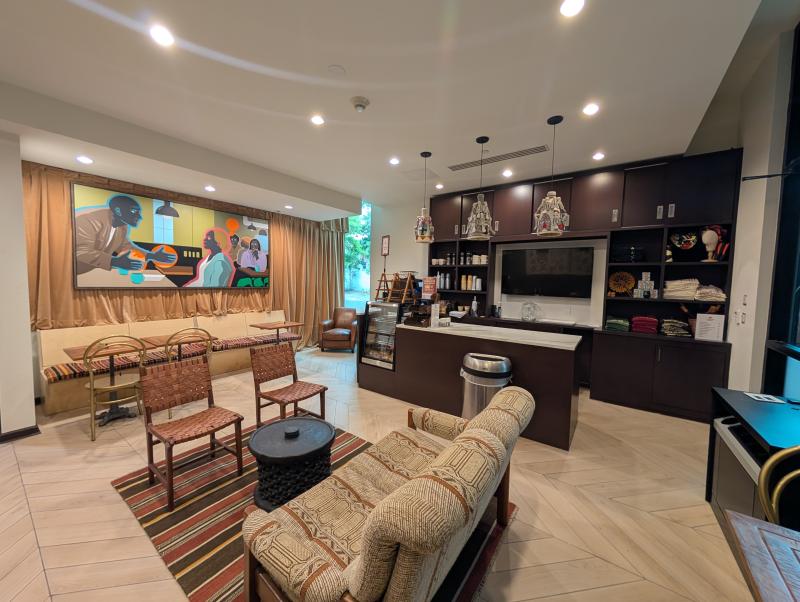
A new gathering space at Hattiloo spotlighting local Black chefs and artisans. Bandele says the food menu will stay intentionally simple. You’ll choose from salty, sweet, or savory, with a different Black chef creating their own three charcuterie-style dishes each quarter. Café Loo will serve as both a pre-show gathering space as well as a community space people can enjoy even when they aren’t staging a production.
Bandele was right, by the way. I may not be a full-on theater guy, but I’m excited to finally see a play there. Yes, I felt a little more cultured saying that. And I can’t wait for Music Box and Laugh Box.
Twenty years in, Hattiloo is still finding new ways to bring Memphis through its doors. Turns out, you don’t have to be a theater person to find something there for you.
Want to see what's on stage? Read our complete guide to Hattiloo's 20th season.
Follow along on Instagram, Facebook, and Twitter, and visit hattiloo.org for tickets and the full Season 20 calendar.

Comments Make Us Happy